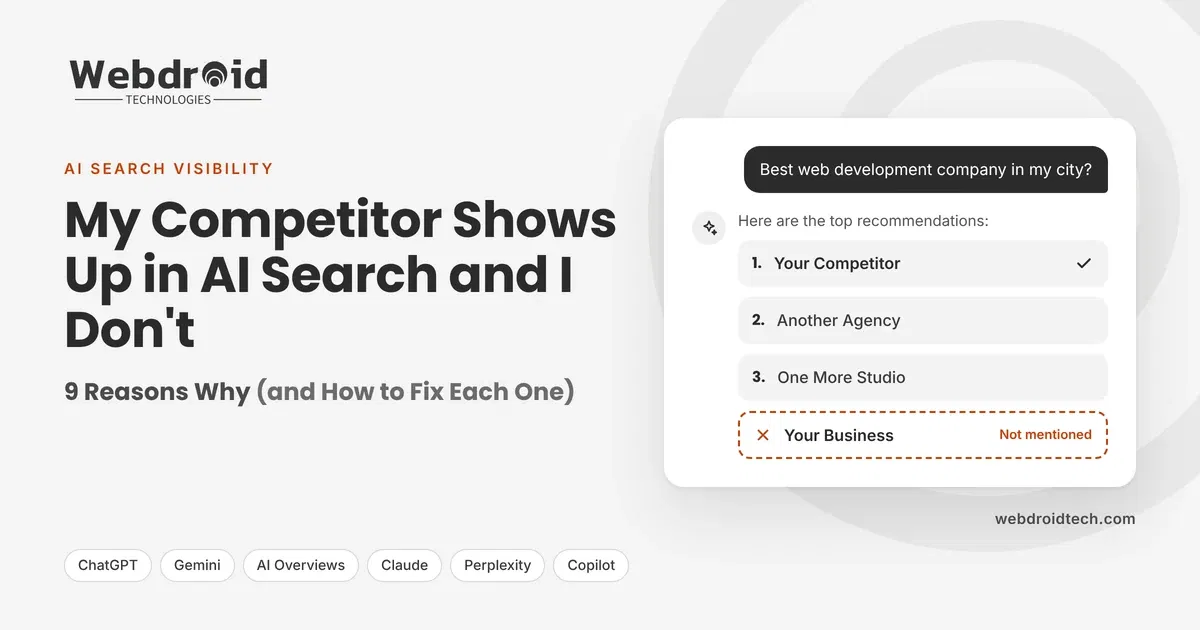
You ask ChatGPT for the best company in your field in your city. It names three businesses, and one of them is your biggest competitor. You try Gemini, then Perplexity. Same story. Your business, with years of happy customers, isn’t mentioned anywhere.
It’s frustrating, but it’s rarely bad luck. AI assistants recommend the businesses they can find, understand and trust. If a competitor keeps getting named and you don’t, there’s usually a clear reason, and most of those reasons can be fixed.
Quick answer: Your competitor probably appears in AI search because AI tools can access their website, they rank well in Google and Bing, their business details are consistent across the web, and other trusted sites talk about them. To catch up, unblock AI crawlers, strengthen your regular search rankings, publish clear pages that answer customer questions, fix inconsistent business listings, and earn more reviews and third-party mentions.
Where each AI tool gets its answers
Not every AI assistant works the same way. Here’s where the major tools look when someone asks for a business recommendation, and which crawler needs access to your site.
| AI tool | Where it mainly finds information | Crawler to allow on your site |
|---|---|---|
| ChatGPT | Its training data, plus live web search for local and buying questions | OAI-SearchBot |
| Google AI Overviews & AI Mode | Google’s normal search index | Googlebot |
| Google Gemini app | Google’s search index, used to ground its answers | Googlebot, and don’t block Google-Extended |
| Claude (Anthropic) | Its training data, plus its own web search | Claude-SearchBot and Claude-User |
| Perplexity | Its own live search index, with sources cited in every answer | PerplexityBot |
| Microsoft Copilot | Bing’s search index | Bingbot |
The pattern is clear: every AI tool depends on being able to read your website and on search indexes like Google’s and Bing’s. That’s where most of the nine reasons below begin.
9 reasons your competitor appears in AI search and you don’t
1. You’re blocking AI crawlers without knowing it
Why it happens: Many websites block AI bots by accident, through an old robots.txt rule, a security plugin, or a hosting firewall that challenges anything automated. Each AI company uses its own crawler. OpenAI says sites that block OAI-SearchBot won’t be shown in ChatGPT search answers. Anthropic warns that blocking Claude-SearchBot may reduce your visibility in Claude’s search results. Perplexity’s index is built by PerplexityBot, so blocking it removes you from that index.
How to fix it: Open yoursite.com/robots.txt and check that OAI-SearchBot, Claude-SearchBot, Claude-User, PerplexityBot, Googlebot and Bingbot aren’t disallowed. Then ask your developer or host to confirm that bot protection isn’t blocking them at the firewall. One useful detail: blocking Google-Extended doesn’t remove you from Google’s AI Overviews, but it does stop Google using your content to ground answers in the Gemini app.
2. Your competitor ranks higher in regular search
Why it happens: AI search is still built on search. Google says its AI features are rooted in its core search ranking systems, and ChatGPT’s live answers have been closely linked to Bing’s results. If your competitor is on page one and you’re on page three, AI tools are far more likely to find them first.
How to fix it: Keep investing in the SEO basics: a fast, mobile-friendly site, a clear page for each service, strong internal linking, and backlinks from relevant websites. Better rankings and better AI visibility usually grow together.
3. You only exist on Google
Why it happens: Many businesses set up Google Search Console and stop there. But Microsoft Copilot runs on Bing, ChatGPT search has leaned heavily on Bing, and Perplexity runs its own index. If those systems barely know your site, you’re invisible to a large share of AI users.
How to fix it: Verify your website in Bing Webmaster Tools, submit your sitemap, and turn on IndexNow so new pages are picked up quickly. Claim your Bing Places listing as well as your Google Business Profile.
4. AI can’t tell exactly what you do, or where
Why it happens: A homepage that says “We deliver innovative solutions” tells AI nothing. If your services, locations and ideal customers aren’t spelled out in plain text, AI tools can’t match you to a question like “Who builds Shopify stores for small brands in Indore?”
How to fix it: Create a dedicated page for each core service and each main location. State plainly what you do, who it’s for, where you work and what makes you different. Add structured data (Organization or LocalBusiness, Service and FAQPage schema) so machines can read those facts without guessing.
5. Your business details don’t match across the web
Why it happens: AI tools cross-check information from many sources. If your name, address, phone number or website differ between your site, Google Business Profile, directories and social profiles, the AI becomes less confident about who you are, and a competitor with clean, consistent details looks like the safer recommendation.
How to fix it: Choose one exact version of your business name, address, phone number and description, and update every listing to match. Remove or correct duplicate and outdated listings, especially after a move or rebrand.
6. Other websites talk about your competitor, not you
Why it happens: AI assistants give a lot of weight to what independent sources say. If your competitor appears in “best of” lists, industry directories, local news, partner websites, podcasts and forum threads, while you appear only on your own website, the AI has far more evidence that they’re a trusted choice.
How to fix it: Build your footprint beyond your own site. Get listed in respected industry and local directories, pitch guest articles and expert comments, ask partners and happy clients to mention you, and join genuine conversations on Reddit, Quora and industry communities. Aim for real mentions, not spam.
7. Your content doesn’t answer questions directly
Why it happens: People ask AI full questions, like “How long does it take to build an e-commerce website?” If your pages bury the answer under long introductions, or never answer it at all, AI tools will quote a competitor whose page answers clearly. Research supports this. In the peer-reviewed GEO study from Princeton researchers, adding statistics, citations and quotations were among the most effective ways to make AI answers use a page.
How to fix it: Use real customer questions as headings and answer each in the first one or two sentences. Add specific numbers, examples and sources, and a short FAQ on every important page.
8. Your competitor has more, and better, reviews
Why it happens: Reviews are public proof that real people trust a business. A competitor with 200 detailed reviews will usually look more recommendable than one with 12 short ones, both to search engines and to AI assistants that summarise what customers say.
How to fix it: Make asking for reviews part of your process. Send a short message with a direct link after each project, and encourage specifics such as the service, the result and the timeline. Reply to every review, positive or negative, professionally.
9. Your information is outdated or hard for AI to read
Why it happens: AI tools favour content that’s current and easy to process. Old blog dates, outdated prices or services, key details locked inside images or PDFs, and pages that only load their text through heavy JavaScript can all make your site harder to understand. Perplexity in particular leans on fresh content in its live index.
How to fix it: Review your main pages every few months, show “last updated” dates, put important information in real HTML text, and make sure your site loads quickly on mobile. Remove or update pages for services you no longer offer.
How to check whether every AI tool recommends you
Test all the major assistants, not just one. They use different sources, so you may appear in one and not another. Once a month, ask ChatGPT, Gemini, Google AI Mode, Claude, Perplexity and Copilot questions like:
- “What are the best [your service] companies in [your city]?”
- “Who would you recommend for [your service] for a small business in [your city]?”
- “Tell me about [your business name]. Are they good for [your service]?”
- “What are good alternatives to [competitor name]?”
Note which businesses are named, whether the details about you are accurate, and which websites each tool cites. Those cited sources are your to-do list: they’re the places you need to appear.
Frequently asked questions
1. Why does ChatGPT recommend my competitor but not my business?
Usually because your competitor is easier for AI to find, understand and trust: better search rankings, clearer content, consistent business details, more reviews and more mentions on other websites. Fix those signals and your chances improve.
2. Do Gemini, Claude and Perplexity use the same sources as ChatGPT?
No. Google’s AI tools rely on Google’s search index, Microsoft Copilot uses Bing, Perplexity runs its own index, and ChatGPT and Claude combine training data with their own web search. That’s why you should optimise broadly and test each one separately.
3. Will blocking AI training bots hurt my AI search visibility?
It depends on the bot. Training crawlers and search crawlers are separate. You can block training crawlers like GPTBot or ClaudeBot and still allow search crawlers like OAI-SearchBot and Claude-SearchBot. Blocking the search crawlers is what removes you from AI answers.
4. How long does it take to start appearing in AI answers?
Technical fixes, such as unblocking crawlers, can work within days. Building rankings, reviews and mentions usually takes weeks to months, so start with the quick wins and keep going.
5. Can I pay to be recommended by AI assistants?
Organic recommendations in tools like ChatGPT, Claude and Perplexity can’t be bought. Be cautious of anyone promising guaranteed placement. What you can do is strengthen the signals these tools rely on.
6. Is AI search optimisation (GEO) different from SEO?
It builds on SEO, because crawlability, rankings and helpful content matter for both. It adds a focus on consistent business information, third-party mentions and content that’s easy for AI to quote.
Stop losing customers to competitors in AI search
At WebDroid Technologies, we help businesses become visible, and recommended, across ChatGPT, Gemini, Google AI Overviews, Claude, Perplexity and Copilot. We start by checking what each AI tool says about you and your competitors today, then fix the gaps one by one.