
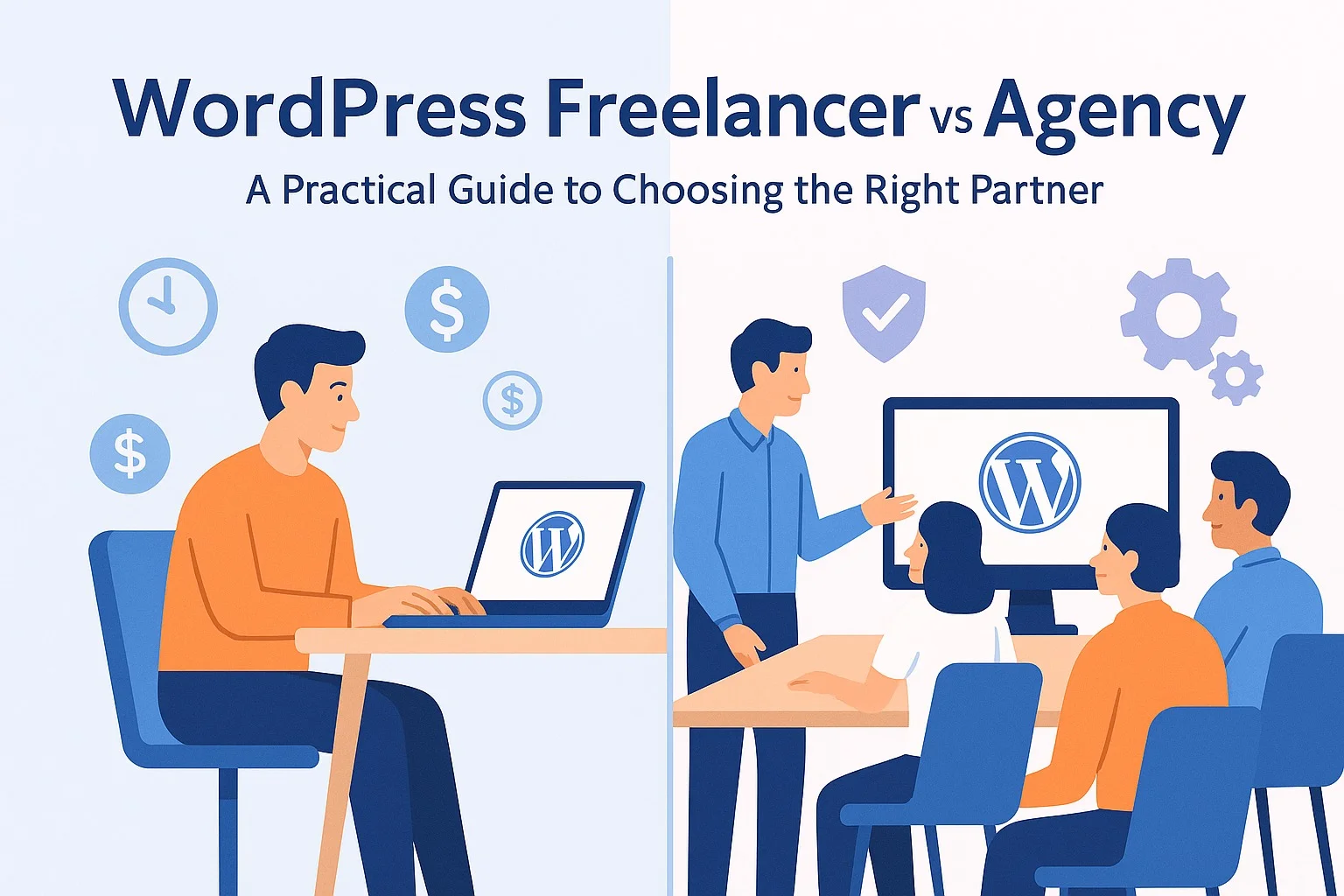
Introduction
Choosing the right WordPress partner can make or break your next web development project. Whether you are launching a new startup website, rebuilding your company’s digital presence, or scaling a complex e-commerce platform, the decision between hiring a WordPress freelancer or partnering with a dedicated development agency is crucial for your long-term success.
Why Choosing the Right WordPress Partner Matters
The WordPress ecosystem powers over 43% of all websites globally, making it the most dominant content management system in the world. This market leadership has created a vast marketplace of WordPress development services, ranging from solo independent contractors to full-service Digital marketing services agencies with specialized teams. Your choice will impact not just your budget and timeline, but also the resulting code quality, scalability, and long-term maintenance of your site.
Making the wrong choice can lead to missed deadlines, budget overruns, and a website that fails to meet your business objectives. Conversely, selecting the right collaborator ensures a professional, secure result with the ongoing support necessary for growth.
Rise of WordPress Website Demand in 2025
Demand for expert Web Development services has surged dramatically. Businesses of all sizes are recognizing that a robust, high-performing web presence is not just a necessity but a primary driver of revenue and competitive advantage. In 2025, digital transformation continues to accelerate, making the need for specialized WordPress expertise higher than ever.
What the Reader Will Learn in This Comparison
This comprehensive guide will systematically compare the two primary hiring models—freelancer versus agency—across critical dimensions like cost, expertise, reliability, and support. By the end, you will have a clear decision-making framework to choose the ideal partner for your specific project needs.
What Is a WordPress Freelancer?
Definition
A WordPress freelancer is an independent contractor who offers WordPress development services on a project-by-project or hourly basis. They are solo professionals who run their own business, meaning you hire a single person who is responsible for all aspects of the job, from client communication and design to coding and launch.
Work Style
Freelancers are defined by their flexibility and personalized approach. They often work remotely, managing their time and workload independently. This typically results in a direct, one-on-one communication style, providing clients with singular accountability. Their processes are often lean and informal, enabling rapid adjustments and faster turnarounds for smaller tasks.
Types of Freelancers
- WordPress Designer:Focuses heavily on the visual aspects, user experience (UX), and user interface (UI), often using page builders (like Elementor or Divi) and pre-built themes.
- WordPress Developer:Concentrates on back-end tasks, custom coding, PHP development, plugin creation, and integrating third-party services.
- Full-Stack Freelancer:A rare and highly valued individual who possesses expertise across design, front-end, and back-end development. They can handle a project from start to finish.
Best Use Cases
Freelancers excel in situations where the project scope is clear, budget is tight, and speed is a priority:
- Simple blog setup or portfolio websites.
- Minor website updates, theme customizations, or bug fixes.
- One-off needs for specific, niche expertise (e.g., performance optimization).
What Is a WordPress Development Agency?
Definition
A WordPress development agency is a registered company composed of a multidisciplinary team of specialists. They provide comprehensive Web Development services under a structured business framework, offering a single point of contact for complex or long-term business needs.
Team Structure
The key advantage of an agency is the depth of expertise provided by its team structure, which typically includes:
| Role | Responsibility |
| Project Manager (PM) | Oversees the entire process, manages timelines, budget, and acts as the client’s main point of contact. |
| UI/UX Designers | Focus on creating the visual aesthetics and ensuring the site is intuitive and user-friendly. |
| Front-End Developers | Build the client-side of the website (what the user sees) using HTML, CSS, and JavaScript. |
| Back-End Developers | Handle server-side logic, database interaction, custom functionality, and plugin development. |
| QA Specialists | Rigorously test the website for bugs, security vulnerabilities, and performance issues before launch. |
| SEO/Digital Marketers | Integrate foundational SEO and often offer ongoing Digital marketing services. |
Types of Agencies
- Boutique Agencies:Smaller, highly focused firms that often specialize in a specific niche (e.g., WooCommerce, enterprise maintenance, or a particular industry). They offer a more personalized touch.
- Enterprise Agencies:Larger firms capable of handling massive-scale projects, high-volume e-commerce, and complex API integrations for multinational corporations.
Best Use Cases
Agencies are the superior choice when complexity, reliability, and scale are paramount:
- Large-scale e-commerce platforms or custom membership sites.
- Complex migrations or integration with existing CRM/ERP systems.
- Long-term partnerships requiring guaranteed support, maintenance, and Digital marketing services.
Key Differences Between Freelancers and Agencies
The core differences boil down to a trade-off between cost and comprehensive resources.
| Feature | WordPress Freelancer | WordPress Development Agency |
| Cost & Pricing | Lower hourly rates, highly competitive project pricing. Best for small budgets. | Higher overall project cost due to overhead and team size. Best for high-value projects. |
| Skillset & Expertise | Depth in one or two areas (e.g., design OR development). A single point of failure for expertise. | Breadth of specialized skills (design, development, QA, SEO) working collaboratively. |
| Timeline & Speed | Faster turnaround on small, defined tasks. Slower on complex projects due to limited individual capacity. | Slower discovery phase. Faster execution on complex builds due to parallel workflow and larger team capacity. |
| Communication | Direct, personal, and highly flexible communication. | Structured, process-driven, usually managed by a dedicated Project Manager. |
| Maintenance & Support | Support is often ad-hoc, limited by personal availability, and may require a separate contract. | SLA-based (Service Level Agreement) support is standard, guaranteeing response times and ongoing maintenance. |
| Risk & Reliability | Higher risk: dependence on one person’s health, availability, or skill set. | Lower risk: team redundancy ensures continuity, corporate structure provides legal accountability. |
| Scalability | Low scalability. Growth is limited by the individual’s time. | High scalability. Teams can be rapidly expanded to meet new project requirements or business growth. |
Pros & Cons of Hiring a WordPress Freelancer
| Pros | Cons |
| Lower Cost | Limited Bandwidth |
| More affordable, especially for simple or smaller projects with lower budgets. | Can only handle a limited number of clients or a small scope of work at once, leading to slower progress on larger builds. |
| Personalized Attention | Single Point of Failure |
| Direct, one-on-one communication with the person doing the work. | If the freelancer gets sick, overbooked, or disappears, your project halts entirely. |
| High Flexibility | Narrow Skillset |
| Easier to make quick changes and adjust scope without rigid contractual processes. | Rarely masters every skill (design, development, security, SEO, Digital marketing services). May require you to hire multiple specialists. |
| Faster Start Time | Variable Reliability |
| Less bureaucracy means they can often begin work almost immediately. | Reliability is dependent on the individual’s business practices and discipline. |
Pros & Cons of Hiring a WordPress Development Agency
| Pros | Cons |
| Comprehensive Expertise | Higher Cost |
| Access to a full team of specialists (UI/UX, SEO, QA) under one roof for holistic Web Development services. | Significantly more expensive than a freelancer due to greater overhead costs. |
| Guaranteed Reliability & Stability | Less Personal Connection |
| Team redundancy, formal contracts, and business longevity minimize project risk. | Communication is filtered through a Project Manager, which can feel less direct. |
| Scalability & Capacity | Slower Start Time |
| Can handle complex, multi-faceted projects and scale the team as your business grows. | Requires a formal discovery and onboarding process, which extends the initial timeline. |
| Structured Workflow | Lower Flexibility |
| Established processes for QA, testing, and deployment ensure high-quality, professional results. | Changes to the project scope mid-way are often more challenging and costly to implement. |
Which Option Fits Your Project Type?
The optimal choice always depends on the size, complexity, and desired longevity of your project.
For Small Projects (Landing Pages, Blogs)
Recommendation: WordPress Freelancer.
A freelancer offers cost-efficiency and speed for projects that have a defined, simple scope. They can quickly implement a theme or set up a basic structure.
For Medium Projects (Portfolio, Corporate Sites)
Recommendation: Experienced Freelancer or Boutique Agency.
For a custom corporate site that requires a unique design and moderate custom functionality, a boutique agency ensures all bases (UI/UX, development, security) are covered. An experienced full-stack freelancer can also be a viable, cost-saving option if their portfolio is strong.
For Large & Complex Projects (eCommerce, LMS, Custom Plugins)
Recommendation: WordPress Development Agency.
These projects require multiple specialized skills working in parallel (e.g., database architects, front-end designers, and security experts). The structured workflow, QA process, and guaranteed reliability of an agency are essential for building robust, scalable Web Development services solutions.
For Long-Term Projects (Maintenance, SEO, Continuous Updates)
Recommendation: WordPress Development Agency.
Ongoing needs—especially those involving guaranteed uptime, security patches, and continuous Digital marketing services—are best suited for an agency retainer. They provide the SLA-based support and team capacity necessary for long-term stability.
Detailed Cost Comparison
While a freelancer may have an hourly rate of $35–$80 USD, and an agency may charge $100–$250+ USD per hour, the true cost comparison requires looking beyond the hourly rate to the total project cost and the associated risks.
Typical Freelancer Pricing
Freelancers typically charge lower upfront fees because they have minimal overhead.
- Hourly:Simple tasks or maintenance.
- Per Project:Common for defined builds, such as a 5-page business site.
Typical Agency Pricing
Agencies have higher pricing to cover specialized teams, tools, and processes.
- Packages:Fixed-price packages for standard websites.
- Retainers:Monthly agreements for ongoing maintenance, support, or Digital marketing services.
ROI Comparison
- Freelancer ROI:High for small, low-risk projects. The value is speed and low upfront cost.
- Agency ROI:High for complex, mission-critical websites. The value is derived from reduced risk, higher quality code, better performance, and superior scalability. Investing more upfront often prevents costly rebuilds or security issues down the line.
Hidden Costs to Consider
When hiring a freelancer, you may incur hidden costs such as hiring a separate QA tester, buying professional-grade premium tools, or hiring an SEO specialist, which an agency typically includes in their core WordPress development services.
Quality, Security & Performance
In 2025, website quality is defined by three key factors: speed, security, and code quality.
- QA & Testing Practices:Agencies integrate a formal QA (Quality Assurance) process, where a dedicated specialist tests the site before launch. Freelancers, while diligent, often self-test, which is less rigorous.
- Advanced Security Implementation:Agencies possess the resources and specialized knowledge to implement enterprise-level security protocols, including code reviews, penetration testing, and advanced firewall configuration, which is a core component of professional Web Development services.
- Performance Optimization (Speed, Caching, CDN):Both can optimize for speed, but agencies often leverage a dedicated team of performance engineers and premium infrastructure partnerships to guarantee top-tier load times and Core Web Vitals scores.
- Code Quality & Scalability:An agency’s code is often written to be clean, well-documented, and scalable because it must be maintained by multiple developers. This makes future updates and team transitions much smoother.
Maintenance, Support & Warranty
Maintenance is where the biggest divergence between the two models occurs.
Freelancer Support Limitations
Freelancer support is inherently limited by their personal availability. While many offer great post-launch support, they cannot guarantee a Service Level Agreement (SLA). If they are ill, on vacation, or busy with a new project, your urgent support request will have to wait.
Agency SLA-Based Support
A reputable agency provides WordPress development services backed by an SLA—a guaranteed commitment to response times for bug fixes or security issues. This is crucial for e-commerce sites or corporate portals where downtime equals lost revenue. Agencies offer long-term stability through maintenance retainers.
Why Ongoing Updates Are Essential
Regular security patching, plugin updates, and core version checks are non-negotiable for a healthy WordPress site. An agency’s managed maintenance plan offloads this critical work from your team, ensuring continuous security and performance.
Who Provides Better Long-Term Stability
For long-term, mission-critical projects, an agency provides superior stability and peace of mind due to team redundancy, formal processes, and contractual support guarantees.
Checklist: How to Decide Between Freelancer vs Agency
To determine the right partner for your project, use this checklist to assess your primary needs:
| Requirement | Choose Freelancer If… | Choose Agency If… |
| Budget Considerations | Your budget is tight and the project is straightforward. | You have a substantial budget and value reliability and comprehensive services. |
| Timeline Requirements | You need a quick, simple task done with high individual flexibility. | Your project is complex, requires parallel work streams, and has a firm, mission-critical deadline. |
| Level of Expertise Needed | You need a specialist in one specific area (e.g., a specific theme customization). | You need a team of specialists for design, development, SEO, and QA. |
| Project Complexity | The project is small, simple, and has a clear, unchanging scope (e.g., a landing page). | The project is large, requires custom coding, integrates with APIs, or is an e-commerce platform. |
| Support Expectations | You are comfortable managing your own security and maintenance, or only need ad-hoc support. | You require guaranteed, SLA-backed, 24/7 support and long-term maintenance. |
| Risk Tolerance | You have a high tolerance for risk and a plan for contingencies if the freelancer becomes unavailable. | You have a low risk tolerance and require legal accountability and team redundancy. |
Final Recommendation
The choice between a WordPress freelancer and a WordPress development agency is not about one being inherently better; it’s about aligning the partner’s capabilities with your project’s specific needs.
For small, low-budget, and low-complexity projects, a skilled freelancer provides excellent value, flexibility, and direct communication. For medium to large-scale initiatives—especially those requiring diverse skill sets, a robust quality assurance process, and guaranteed long-term support—an agency offers the necessary structure, capacity, and risk mitigation. They provide the comprehensive Web Development services needed for a scalable, secure, and high-performance digital asset.
Regardless of your choice, perform thorough due diligence. Check portfolios, verify client testimonials, and ensure a clear contract is in place that defines scope, timeline, and support.
Decision Framework Summary:
- Simple/Budget-Focused:Freelancer
- Complex/Scalability-Focused:Agency
Need expert WordPress development? If your project demands high-level expertise, a structured workflow, and guaranteed long-term support, look no further.
Let our team at Webdroid Technologies help you build, optimize, and scale your website. We provide comprehensive WordPress development services that align with your business goals, offering a reliable partnership for all your Web Development services and Digital marketing services needs.
FAQs (Frequently Asked Questions)
1. Is it better to hire a WordPress freelancer or an agency?
It depends on your project. Hire a freelancer for small, budget-conscious projects with clear, simple requirements (e.g., a basic blog or portfolio site). Hire an agency for complex, large-scale, or mission-critical projects (e.g., e-commerce, custom plugins, or high-traffic corporate sites) that require diverse expertise and guaranteed long-term support.
2. Are freelancers cheaper than WordPress agencies?
Yes, generally. Freelancers typically offer a lower hourly rate and project price because they have lower business overhead. However, an agency’s higher cost often includes bundled services like QA, Project Management, and specialized security, which you might have to pay for separately when working with a freelancer, sometimes making the final cost comparable for a complex project.
3. Which option offers better long-term support?
A WordPress development agency offers significantly better long-term support. Agencies provide support packages based on a Service Level Agreement (SLA), which contractually guarantees response times and continuous, proactive maintenance. Freelancer support is usually limited to their individual availability and capacity.
4. Who builds websites faster — freelancer or agency?
A freelancer is often faster for small, clearly defined tasks because they have less internal bureaucracy. An agency is faster for large, complex projects because they can assign a team of multiple specialists (designers, developers, QA) to work on different components simultaneously, speeding up overall delivery time.
5. Do agencies provide better WordPress security and performance?
Yes, typically. Agencies follow structured, professional methodologies that include dedicated QA testing, code review, and advanced security implementation as standard Web Development services. They also have the resources to invest in premium performance tools and infrastructure, resulting in a more secure and faster website out of the box.
6. What skills should I look for in a WordPress developer?
Look for:
- Core Skills:Expertise in PHP, HTML, CSS, JavaScript, and MySQL.
- WordPress Specifics:Deep knowledge of the WordPress Codex, custom theme development (not just page builder use), and custom plugin development.
- Soft Skills:Clear communication, strong problem-solving abilities, and demonstrable project management skills.
7. Can freelancers build complex WordPress websites like eCommerce or LMS?
Yes, they can, but with limitations. A highly experienced full-stack freelancer might be able to manage a complex build, but it will take significantly longer and carries a higher risk due to a single point of failure. Agencies are inherently better suited for these projects because they can deploy a specialized team to handle the complexity, scale, and rigorous testing required.
8. How do I verify if a freelancer or agency is trustworthy?
- Portfolio:Review case studies of similar projects they have completed.
- Reviews & Testimonials:Check third-party review sites (like Clutch or Google Reviews) and independent client testimonials.
- Contract:Insist on a clear, detailed contract outlining deliverables, timelines, and support guarantees.
- Professional Presence:Verify their LinkedIn profiles and look for active contributions to GitHub or the WordPress community.
9. What questions should I ask before hiring a WordPress developer?
- “What is your standard QA and testing process before launch?”
- “Can you show me a site you built that required similar custom functionality to mine?”
- “What happens if you are unavailable during a critical time?” (For freelancers)
- “What ongoing maintenance and support packages do you offer?” (For agencies)
- “How do you ensure the website is optimized for performance (speed and Core Web Vitals)?”
10. Which option gives better ROI — freelancer or agency?
The option that gives better ROI depends on the project’s long-term value. For simple projects, the freelancer offers a faster return on a small investment. For complex, business-critical projects, the agency offers better ROI, as their higher upfront investment yields a more secure, scalable, and professional digital asset that minimizes future technical debt and costly downtime.